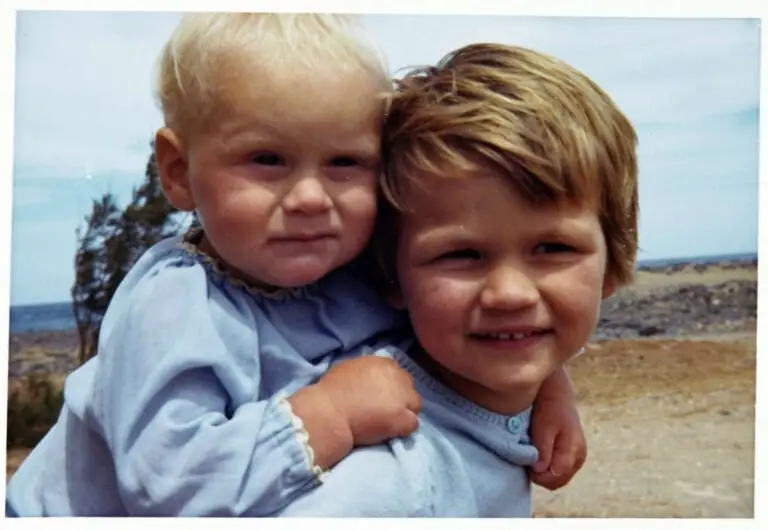

The shock was brutal. The kind of event that divides a life into “before” and “after.”
But I coped the way many high-achieving women are taught to cope.
I pushed through. I buried the grief. I escaped into busy clinical work as a young GP, wearing my exhaustion like a badge of honour and using my productivity as a shield.
In the years after losing my brother, something shifted at work.
Cynicism crept in quietly. I found myself clock-watching during consultations. Feeling irritated by trivial complaints that once would have moved me to compassion.
The empathy that had drawn me to medicine in the first place was draining away, and I didn’t understand why.
I was burning out. Not from General Practice but from carrying unprocessed grief while trying to hold everything together through sheer willpower.
I told myself I was strong. I told myself I was resilient.
I believed that if I just kept moving fast enough, the pain of losing my brother wouldn’t catch me.
And for a while, it worked. Or so I thought.
At a funeral for someone I barely knew, that strategy collapsed.
But sitting in that pew, without my usual distractions (my pager, patients, the never-ending to-do list), a chasm of grief opened without warning.
The carefully constructed dam I’d built over five years didn’t just leak. It burst.
I shook. I sobbed. I was inconsolable throughout the entire service, in this very public space.
I felt exposed and utterly confused. Why now? Why here?
I didn’t know then what I know now about what happens when you bury difficult emotions.
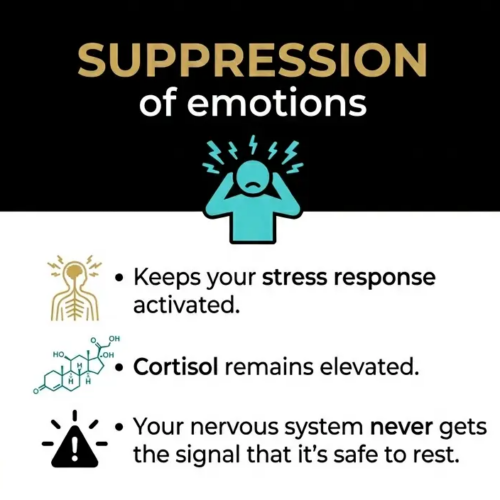
We often think of suppression as
passive. Like putting a lid on a box and forgetting about it.
But neuroscience tells us that suppression is active. Cognitively expensive. Exhausting.
A major meta-analysis looking at over 300 studies confirmed this: trying to suppress difficult emotions leads to more distress, not less.¹ Your heart rate increases. Your stress hormones spike. The psychological cost compounds over time.
When we numb out with busyness, we aren’t dissolving the grief, sadness, anger, or anxiety.
We’re burying it alive.
In a landmark study of healthcare residents, researchers found that emotional suppression is directly associated with higher burnout, even after controlling for workload and demographic factors.²
Meanwhile, those who practiced acceptance (simply observing the emotion without judging it or trying to fix it) recover faster and experienced less distress, not more.³
The difference?
As a doctor with over three decades of medical experience, I know that buried emotions don’t disappear. They wait. They accumulate. They leak out in ways we don’t expect.
Restless sleep. The afternoon crash. Snapping at people we love. Feeling hijacked by our own reactions
The link between grief and burnout is well established in the research. And if we ignore our emotions long enough, the body pays the price.
The cynicism I experienced wasn’t a personality flaw. It was depersonalization, one of the three core dimensions of burnout syndrome. My body was trying to protect me from feeling anything at all because I’d taught it that feeling wasn’t safe.
Emotion is energy. And physics tells us energy can’t be destroyed, only transformed.
When we suppress intense emotions, that energy transforms into tension, inflammation, anxiety, and eventually collapse.
When we honour them, that energy transforms into healing.
By clearing my schedule after my mother’s passing and allowing myself to linger over photos, to cry when I needed to, to feel the full weight of the loss, I was teaching my body that the grief was safe to feel.
And because I felt it, it could move through me.
This isn’t weakness. This is how your body is designed to process difficult emotions. When we stop interrupting that process with distraction and constant doing, genuine recovery becomes possible.
You don’t need to go to a sacred mountain in Japan to do this work (though it helps).
You just need to stop running.
Here’s what that looks like:
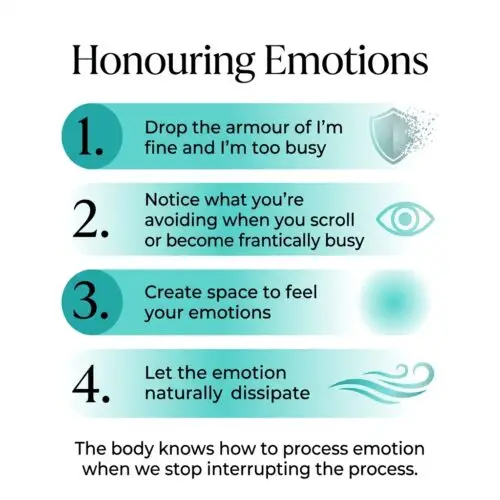
1. Drop the armour of “I’m fine” and “I’m too busy”
If you’re carrying grief, sadness, anger, or anxiety right now, your emotions aren’t the problem. Burying them is.
2. Notice what you’re avoiding
Are you scrolling to avoid feeling lonely? Overworking to avoid grief? Filling your schedule so you don’t have to sit with discomfort? Name it. That’s the first step to shifting it.
3. Create space to feel
Block time in your calendar (yes, literally schedule it). Sit with what comes up. Let yourself cry, rage or feel the heaviness without rushing to fix it or judge yourself for it.
4. Let the emotion naturally dissipate
You don’t have to do anything with it. Just allow it. The body knows how to process emotion when we stop interrupting the process.
This is the bravest thing you’ll ever do. And the most productive, even though it looks like the opposite.
I’ve been away for several months.
And now I’m returning to my work, my business, and this community of high-achieving women who are learning that there’s another way to live beyond exhaustion and constant doing.
I’m more committed than ever.
And I know firsthand that when life breaks you open, the only way through is to feel it. Not to bypass it, productivity-hack it, or push through it.
You don’t need to keep proving your worth through productivity.
You don’t need to outrun your pain.
You just need permission to stop.