You cancel plans with yourself without hesitation but never
miss work deadlines or commitments to others. This pattern reveals something deeper about how you value your own needs.
You had a plan to do something for yourself.
You were going to take that walk. Go to that yoga class. Finally book the doctor’s appointment you have been putting off for months.
But something came up. Something urgent. Something for someone else.
So you cancelled. Again.
And here is what is interesting: you would never do that with a work deadline. Or a commitment to someone else.
As a doctor and in my work with high-achieving women, I see this pattern constantly.
You call it being responsible. Being reliable. Being the kind of woman who gets things done.
But what looks like dedication on the surface is often something much deeper. It is a window into how you have learned to value yourself.
You treat commitments to yourself as optional. Commitments to others as binding.
This is not time management. This is self-abandonment.
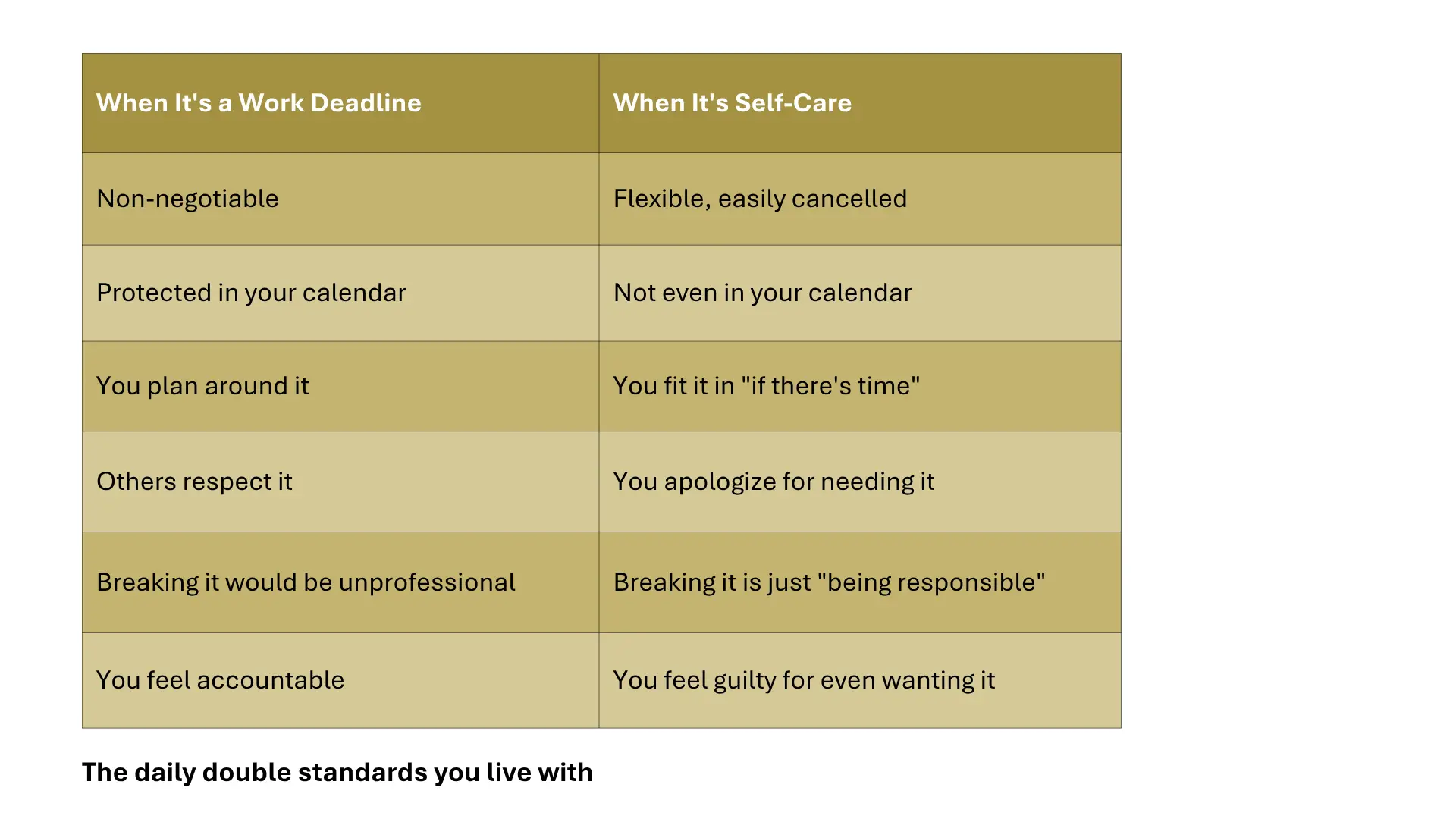
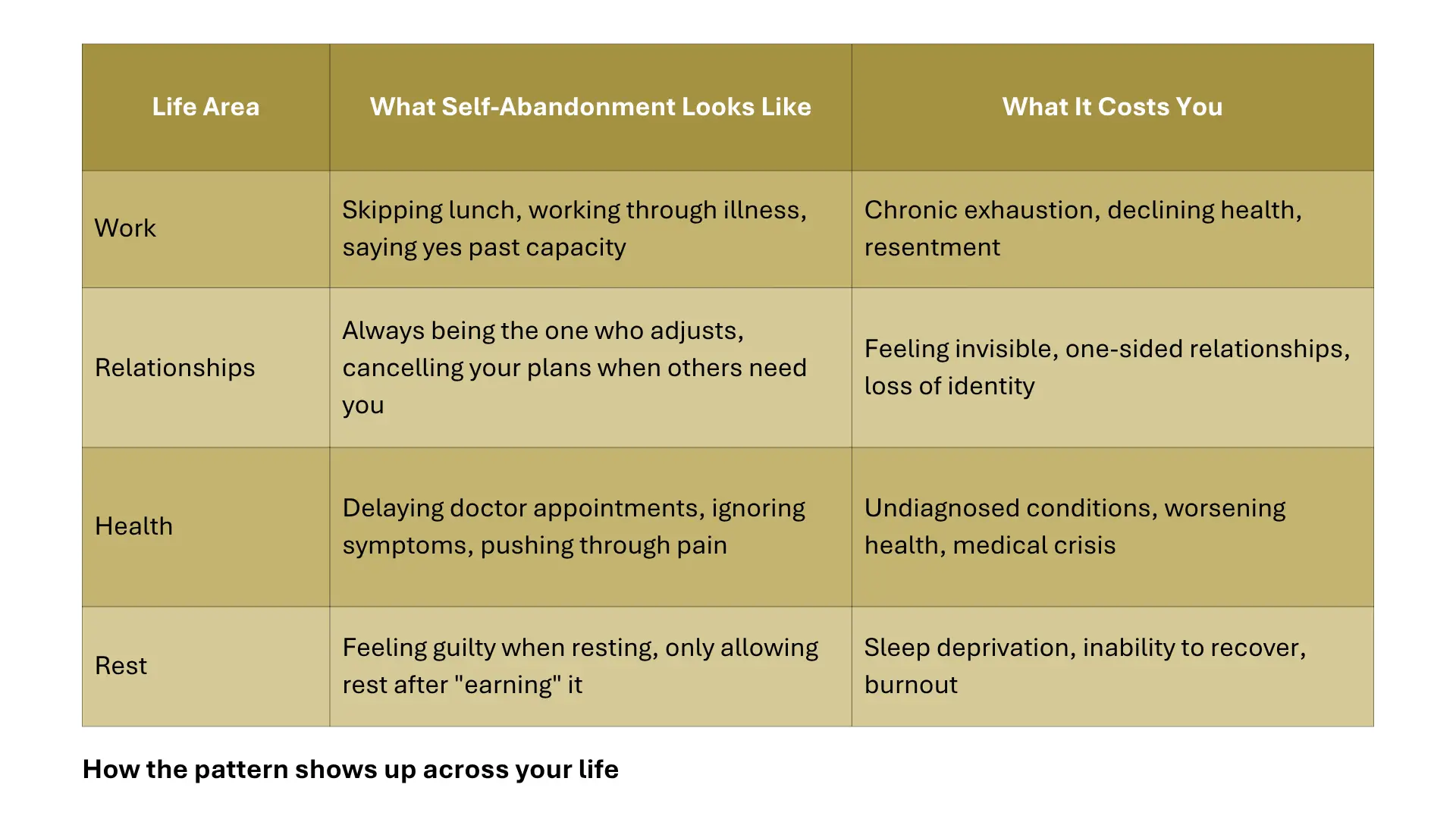
Not occasionally. Not in a crisis. Structurally. Daily. As a way of operating.
It is the skipped lunch because the meeting ran over. The cancelled appointment with yourself because something more urgent (which is to say, something for someone else) came up. The broken promise to go to bed earlier, to take the walk, to say no to the extra commitment.
It is you keeping track of what is due, what has been missed, who needs what, what will fall through the cracks if you stop paying attention. And in that same mental load, your own needs do not even make the list.
It is swallowing what you need so often that you have lost track of what you need.
It is the moment you feel a flicker of resentment and immediately try to override it, because if you were a better person, you would not feel that way about others.
It is continuing to function while exhausted, continuing to give while depleted, continuing to hold while quietly crumbling because stopping feels like a betrayal of everyone who depends on you.
For most of us, it started early.
Perhaps you watched your mother do exactly this: giving endlessly, shrinking her own needs to make space for everyone else's. Perhaps you came to believe a woman’s value is measured by what she gives. That good girls are helpful. That responsible women just get on with it.
Some of this was spoken. Some was modelled. Some was simply absorbed through your role models, your culture, your generation.
And it worked. It earned you approval. It earned you trust. It earned you a reputation as someone who could be relied upon. It made you indispensable.
But the cost is that over time, you stopped being a person with needs and instead became a person who meets the needs of others. Always.
This may sound like responsibility. But the cost of self-abandonment is loss of self-compassion, of joy, of energy and vitality.
These beliefs are usually unconscious. But they are running the show.
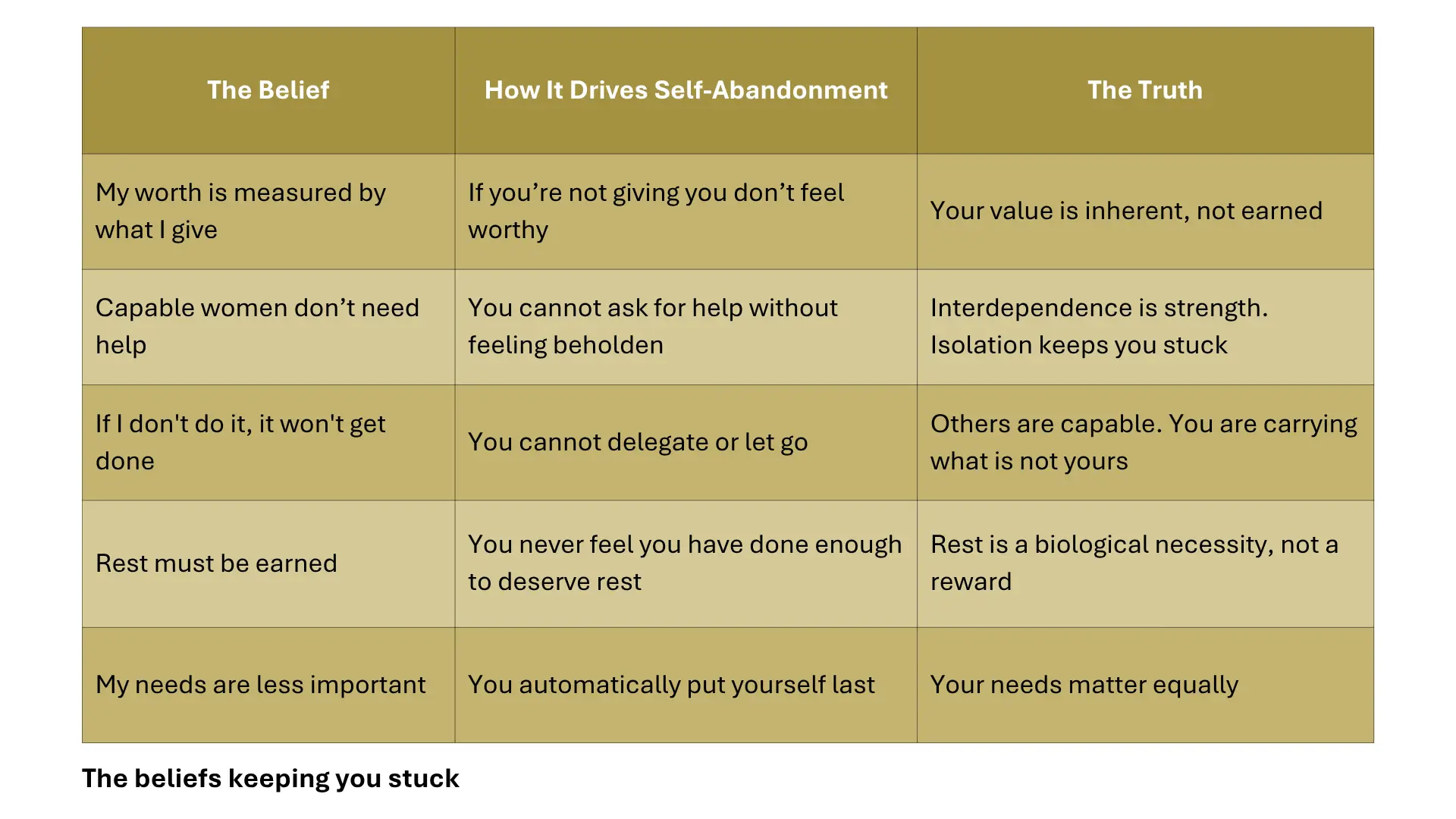
This is not just about discipline. It is about the operating system running underneath your choices. Willpower cannot override a system built on the belief that your needs come last.
Every skipped meal. Every night you push past exhaustion to finish one more thing.
Every time you choose the wine over the walk. Every doctor’s appointment you delay, every symptom you minimise, every boundary you quietly let slide. It is all self-abandonment.
You know what you need. You know what would help. But the operating system that runs your life does not allow you to prioritise it because the system was built on the belief that your needs come last.
This is where identity patterns meet lifestyle medicine. You cannot build sustainable wellbeing on top of a foundation of self-abandonment.
The foundation has to change first.
This is exactly what we explore in depth in The Essential Conversation.
If you want to see your own pattern more clearly, this free live session is designed to help you do exactly that.
If you see yourself here, you are not failing. You are finally seeing what has been driving you.
And once you see it, you can begin to change it.
Track for one week: how many times you cancel something for yourself but protect commitments to others? What are you telling yourself when you do this?
Write it down. Notice the language you use. Notice the speed with which you cancel plans with yourself compared to the guilt you feel cancelling plans with someone else.
The awareness itself is powerful. You cannot change a pattern without fully seeing it.
Treat it with the same seriousness you would a client meeting or work deadline.
Put it in your calendar. Protect it. Do not move it unless you would move a work commitment for the same reason.
Notice what comes up when you try. The guilt. The sense that you should be doing something else. The pull to break the promise to yourself.
That discomfort is the pattern pushing back. Stay with it anyway.
Was it “my needs are not as important”? Was it “I have not earned this yet”? Was it “if I don’t do this for them, I am selfish”?
You have been living with these beliefs for so long they feel like facts. They are not facts. They are learned patterns.
Get support for deeper pattern change
If self-abandonment has been your default for years or decades, changing it on your own can feel almost impossible.
The pattern runs deep. The beliefs driving it are often unconscious. And the guilt that arrives when you try to shift it can be overwhelming.
This is why so many are trapped by their competence but do not know how to address the root cause.
This is work that benefits from structure, community, and someone who understands the territory.
In the Reset & BLOOM Breakthrough , we address this pattern directly. Not with tips or quick fixes, but with neuroscience-informed tools that help you rewire the beliefs keeping you stuck. You learn how to set boundaries without guilt, regulate your nervous system, and rebuild your relationship with your own needs.
Not overnight. Not with a list of affirmations. But with real, sustained, supported work that goes to the root and rewires the beliefs driving the pattern.
A pathway where you can be responsible and well. Where you can give and receive. Where you can succeed and still be whole.
The next Reset & BLOOM Breakthrough starts soon.
Four live weekly sessions for high-achieving women who are tired of overgiving, feeling taken for granted, and running on empty.This is the cycle I see again and again:
Intentionally small. Limited spots.
Join me for a free essential conversation where I explore with you the identity patterns driving exhaustion and what it takes to change them.
Register here for the next session:
Why do I always cancel plans with myself first?
Because your operating system has learned that your needs are negotiable and other people’s needs are not. This is self-abandonment as a structural pattern, not a character flaw.
Is this just poor time management?
No. Time management strategies assume you are protecting your own priorities alongside others. This pattern sacrifices your priorities automatically. The issue is not how you manage time. It is whose needs get prioritised.
How do I stop feeling guilty when I prioritize myself?
The guilt is the pattern protecting itself. It arrives because self-prioritization contradicts your learned identity. The guilt does not mean you are doing something wrong. It means you are doing something different.
Can this pattern really change?
Yes. With awareness, support, and sustained practice. The pattern was learned. It can be unlearned and rebuilt.
