
Tell me if this sounds familiar.
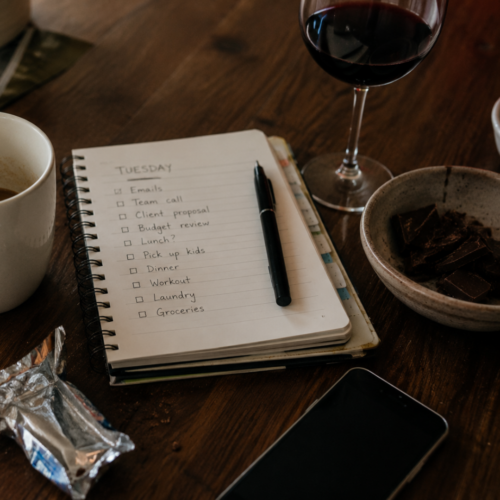
You wake tired. The alarm goes off and your first thought is not about the day ahead – it’s about coffee. Because without it, the day does not start. You know this. You have known it for years.
Breakfast is either rushed or skipped. You meant to eat mindfully, but the emails were already rolling in and there was that thing you had to deal with before the 9am call.
Lunch happens at the desk. Or it does not happen at all. You had good intentions. But the meeting ran over, or the deadline shifted, or someone needed something and before you knew it, it was 2.30pm.
By 3pm, your energy crashes. Hard. Your brain fogs. Your patience thins. And your hand reaches for something sweet (biscuits, chocolate, whatever is nearby) because your body is screaming for fuel and it wants it now.
Dinner is functional. You eat, but you are not really present. You are still processing the day, mentally running through tomorrow, half-listening to a conversation while your mind churns.
And then the wine. A glass. Maybe two. Not because you have a problem. But because it is the only thing that reliably switches your brain off. The only thing that takes the edge off the hum of racing thoughts that has been running since you opened your eyes.
You go to bed later than you should. You sleep lightly. You wake at 3am. And it all starts again.

As both a medical doctor and as a woman who lived this exact cycle for years, here’s what I know: you do not need a meal plan.
And you don’t need someone to tell you that skipping lunch is not ideal or that sugar at 3pm is your body compensating for missed lunch. You already know this.
The question is not when and what to eat. The question is why your self-care is suboptimal even though you know better.
And the answer lies in the underlying unconscious operating system.
When your natural morning cortisol rhythm is blunted (which it is, after months or years of dysregulation), caffeine becomes the replacement.1 Your body is not choosing coffee because it enjoys it. It is choosing coffee because it has lost the internal mechanism that should be waking you up naturally.
When your nervous system has been running in overdrive for an extended period, it reshapes how your body manages energy.
Cortisol (your primary stress hormone) becomes chronically elevated, disrupting blood sugar regulation. Even though your brain is only 2% of your body weight, it uses 20-25% of your total energy.2 With chronic stress:
The whole process is largely unconscious and that’s why it often seems that the first you know of it is when you’ve already devoured half a dozen biscuits.
This is not weakness. It’s neurobiology.
At the same time, stress suppresses your appetite signals. The body deprioritises hunger in favour of alertness – which is why you can go hours without eating and barely notice. Until the crash comes, and then the cravings are overwhelming.3
And the Wine?
Your nervous system has been in overdrive (sympathetic activation) all day. It does not know how to switch off. It has forgotten how.
Alcohol is the fastest available relaxation (parasympathetic) trigger. It down-regulates the nervous system quickly. Your body unconsciously reaches for it not out of habit alone, but because it is genuinely trying to find an off-switch that no longer exists internally.
One of the pillars of holistic wellbeing is nutrition. And I believe deeply in its importance. But I have seen too many high-achieving women try to fix their eating while the underlying identity pattern (the one that leaves no space for themselves) remains intact.
You cannot build good nutrition on top of a day that has no gaps. You cannot prioritise feeding yourself when the operating system says everyone else comes first. You cannot willpower your way to better choices when your nervous system is in survival mode and reaching for the fastest regulation it can find.
The fuel pattern is not separate from the identity pattern. It is its daily expression.
Every skipped meal is The Underappreciated Overgiver in action: her needs go last.
Every 3pm sugar hit is The Lone Strategist pushing through alone: no time to stop, too much to carry.
Every glass of wine is a nervous system that has no other way to come down – because the woman running it has not given herself permission to stop.
The identity pattern must begin to change first.
When the operating system shifts. When self-abandonment is no longer the default. When your nervous system learns to regulate without substances. When your day is structured to include the woman living it.
Your cravings change on their own.
Not perfectly. Not immediately. But sustainably.
I’ve lived this. When my stress levels were at their peak (for years), nothing shifted the weight. It didn’t matter how hard I tried to diet or exercise.
Now that the underlying identity (constant doing equals success) has dissolved, healthy habits are paying off. The excess weight has melted away.
My clients experience the same.
The women I work with do not get a meal plan. They get a new foundation. And the eating, sleeping and energy start to recalibrate once the foundation is in place.
What recalibrates naturally:
